Monday, July 1, 2013

Canada Day 2013

The weather was cool, and breezy.By the late afternoon the rain came.
The crowds were fewer than I remember from last year. The exhibits were fewer.
But then again there was money available from the Federal Government for the
100th. Anniversary of the start of the War of 1812. Next year I expect that our government
will want to push programs to celebrate (bad choice of words here: however, I suspect that
would indeed describe the views of our government) the 100th. anniversary of the start of
World War 1. I however, was willing. I was wearing my Maple Leaf shirt (made in
Cambodia).


One of these days I will work out how to select the right date on my camera.

Monday, July 2, 2012

Canada Day 2012 In Harris Park

It seems traditional now that Canada Day is celebrated each year in Harris Park which is located along the Thames river just a stones throw from downtown. Sunday morning I thought that I would have a look before the big crowds started to show up to see the fireworks in the evening.
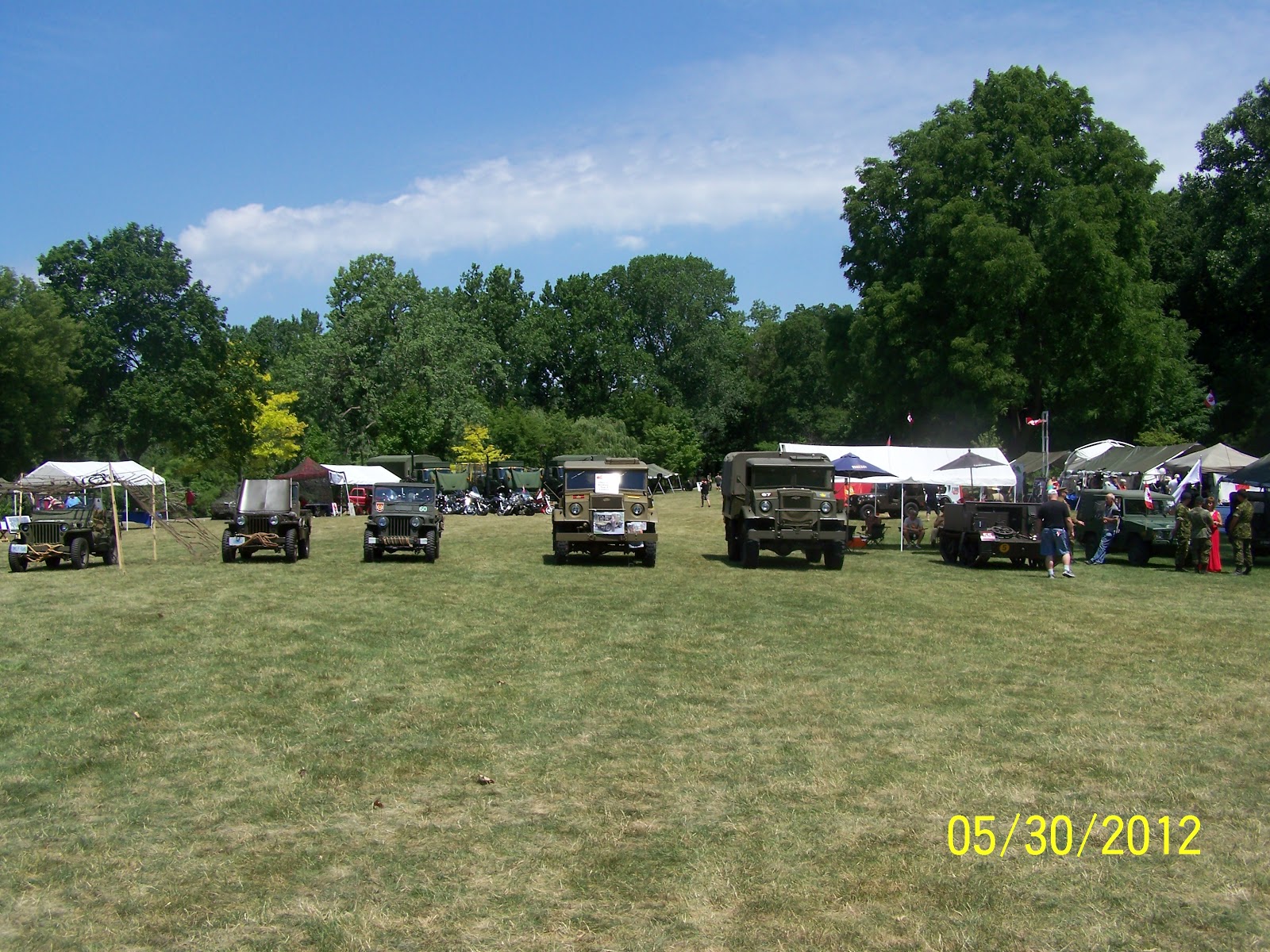
This year there seems to be more space left free in the center of the park. The Thames river is just behind the trees.
The military displays, vehicles, reinactors were located at the north end of the park.
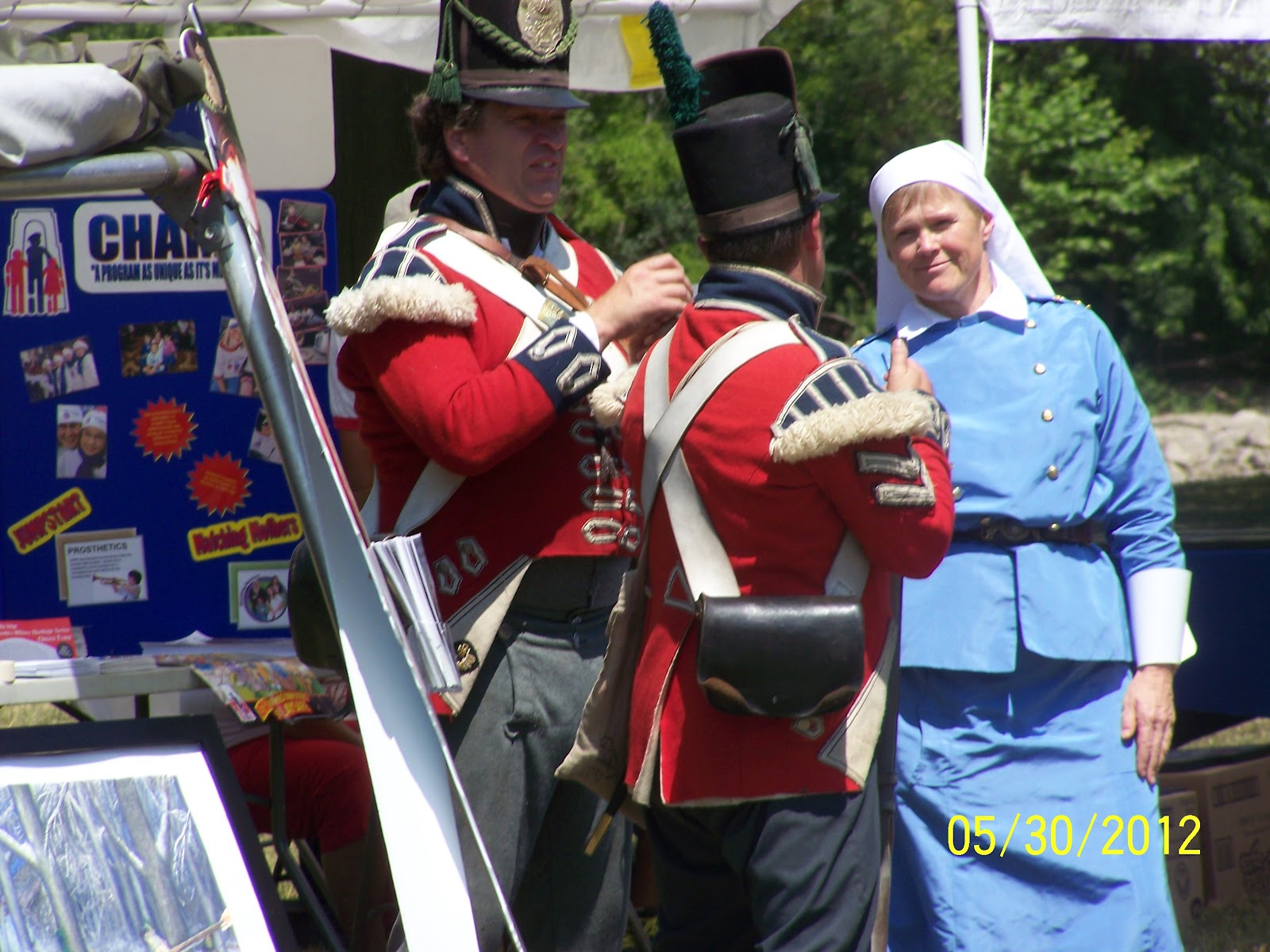
War of 1812 reinactors' booth.
Promoting a book on the 15th. Battalion, a kilted Battalion largely recruited from Toronto.
1812 reinactors with a Bluebird (First World War nursing sisters). Well - there's a hundred years in one photo.
At 12 noon a pow-wow by members of the local reserves which include veterans from the Second World War, and the Korean War.
A display featuring the Museum of Ontario Archaeology. The museum is located in the north-west area of London. It is well worth a visit. Mind you I have a soft spot for the museum as I volunteered for the museum a few years ago.

Wednesday, February 15, 2012

London's 1931 City Council

"Border City Star". December 12, 1931
Mayor George Hayman is on the mayorial dias in the center. In front of him is Sam Baker, London's City Clerk. The aldermen standing are, from left to right, Frank Grey, James Donelly, Frank Curran, A.W. Morrison, Robert Carswell, John Ashton, Harry Rottrill and Timothy J. Donohue. Seated, from left to right, Frank McKay, F. B. Kilbourne, George Hayman, Allen M. Towe, Thomas Copp.

Monday, February 13, 2012

Canada Census 2011

The early returns for last year’s census have been released. Remember, any census is a snapshot in time. Also, the numbers are not exactly accurate. This is in spite of claims by Statistics Canada. I expect that considering the attitude of the Harper Government this will only get worse in the future. I always read population numbers as being plus or minus a thousand or so.

Let’s start with Middlesex County in which London is located.
Statistics Canada, 2011 Census of Population.
Middlesex County showed a population of  439,151 with an increase over 2006 of 4.0%.

There are two ways at looking at the City of London. First is at the Metropolitan Census District.
Statistics Canada, 2011 Census of Population.
The Metropolitan Census District includes some of Middlesex County, some of Elgin County, and the city of St. Thomas. It showed a population of 474,786  with a +3.7% increase in population from 2006.
Statistics Canada, 2011 Census of Population.

The city showed a population of  366,151  with an increase of +3.9% over 2006. I will not even start with the unemployment numbers. It appears that only the City of Windsor lost people over 2006 in Southwestern Ontario.

Tuesday, January 3, 2012

London In 1812 and 1912

I am not very good at looking ahead - so what was London like 200 and 100 years ago ? Here is where Daniel Brock’s book “Fragments From the Forks - London Ontario’s Legacy”, The Aylmer Expess Ltd., 2011 comes in handy. The following are highlights for the two years.
1812:
There are only two entries.

Mahlon Burwell is elected in June to represent the sixth Parliament of the Upper Canada for the riding of Oxford and Middlesex. The election apparently was rigged. Like that is not going to happen again !
Captain Peter Chambers of the 41st. Regiment of Foot together with the flank companies of Oxford Militia march along the Commissioners Road to Delaware. This was to create a diversion on General William Hull’s flank.

London at that time consisted of trees, swamp, quicksand, and rock. There is no indication as to whether or not the squirrels, skunks, raccoons, and deer supported the British or the Americans. The mosquitoes, of course, went after both.

1912:
On January 23 the Young Hebrews’ Social Club is organized.

In March the first Ukrainian Mass is celebrated in St. Mary’s Roman Catholic Church.

On May 25 Beckwith Havens , a staff member of the Glen Curtis Aeroplane Factory, conducts the first air flight over London. Apparently, it started at Carling Farm (to the east of London) flew over Tecumseh Park (at the forks of the Thames), and lasted a whole twenty minutes.


On May 29 the Governor-General the Duke of Connaught, the Duchess, and their daughter Princess Patricia, pay an official visit to London.


On June 7 the London Humane Society is formed. and Lt.-Col. William M. Gartshore is elected President.

William M. Gartshore, Ivey Family London Room, London Public Library, London, Ontario, Canada
The London Fire Department receives its’ first motorized fire truck on September 9th - “Kaiser Bill”. In 1913 the truck is hit by a train.

On December 21 Knollwood Park, Pottersburg, Ealing, and Chelsea Green are annexed to London. The annexations are apparently due to the need to boost London’s population to 50,000 so that the city can run street cars on Sundays.


Friday, November 11, 2011

Veteran's Day 2011

Veteran's Day the eleventh hour of the eleventh day of the eleventh month. It was a very cold morning. The crowd out to watch the parade, and the ceremonies, was very large. I took what pictures I could while maneuvering for room in the crowd.

I really should learn how to reset the day on my camera. Ah - technology.

Friday, October 28, 2011

Charles Milton Richardson Graham, 1868-1932

C.M.R. Graham was born 15 March 1868 in London Ontario to William Graham, and Catherine Richardson. (1) He married Ida Wells Smyth 6 January 1892 in London. The 1901 Census lists him as a gentleman furrier. (2)
"The London Free Press", January 2, 1912.
He became mayor of London in January 1912 to 1914. The Free Press describes his terms in office as marked by aggressive policies. (3)

He had also been involved with the local militia, and in 1915 he was offered the command of the 142nd. Battalion (London’s Own) then being organized in London. When overseas the battalion was broken up for re-enforcements. In 1918 he reverted to the rank of Major, and served with the 18th. Battalion (4). Also in 1918 he was promoted to Lt.-Colonel, and awarded the D.S.O.
"The London Free Press", February 16, 1932.
He died in London on the 15th  of February, 1932.


----------------------------------------------------------------------------
(1) Ancestry.com, Ontario, Canada births and Ontario, Canada, deaths, 1869-1938 and deaths overseas, 1939-1947.
(2) “The London Free Press“, 16 February, 1932. obit. The Free Press described him as in the gent’s furnishing business up to 1916 when he sold his share of the business to his brother.
(3) A term at that time was one year. Elections were held every January. He was recognized as a Conservative in politics. With Sir Sam Hughes in charge that took precedence over any military experience. In spite of this he was an exception to the rule as he proved to be quite a good junior officer at the front.
(4) The 18th. Battalion was the second battalion to be raised from Southwestern Ontario, and was in the trenches by the end of 1915.

Canada 150

Canada 150 is a national campaign to encourage Canadians to collect their life stories, family and community histories. The idea is to collect, and document, these collections for the upcoming 150 anniversary of the founding of Canada in 2017. For further information go to the Canada 150 web page.

Sunday, October 16, 2011

Fragments From The Forks

I attended the book launch on Saturday of Daniel J. Brock's new book "Fragments From The Forks" at the Attic bookshop here in London. Sponsored by the London and Middlesex Historical Society the book launch was well attended. As a member of the Society I was able to get my own copy.

According to the author this book is the result of 30 years of patiently accumulating data on London's history. For over 500 pages -in chronological order- it lists events, people, and well -fragments- of London's history. I would not necessarilly refer to this book as a history but more of a reference book. The index is very well done, and this as much as anything makes this book a useful reference tool.

At the back of the book Daniel Brock has included tables of demographic and area stastics, listings of public officials, and a price index calculator.

In my own area of interest which is the military history of the region quite a bit has been missed; however, that in no way takes away from the usefulness of the volume.

The book is published by the Aylmer Express Ltd. and is available for $40 for the softcover and $50 for the hard cover edition.

Wednesday, October 5, 2011

London 1900

An ad from "The London Advertiser" January 3, 1900. Kingsmill's is still around. As kids we called it the Quiet store.
It is the new century. As those of us who witnessed the change from the twentieth to the twenty-first century know that it is a big event. Right. Well - not if you go through 1900 in the two London dailies. As far as I can tell there were no big parties. At least none reported in the papers. Head line news in January 1900 was the war in South Africa. British Empire troops were kicking ass. At least as far as the London papers were concerned. A large crowd turned out to see off London’s boys who volunteered for the Mounted Rifles. Both papers would continue to closely follow their adventures in South Africa.

Frederick George Rumball (1) was elected mayor in January 1900( mayors at that time served one term, and were elected in early January).

From "The London Free Press, October 1, 1940. It's the only picture that I have been able to find of Mayor Rumball. I expect that in 1900 he had darker hair.
The century may have changed but London did not. Electricity was yet to come. Public transit was horse drawn. Homes were heated by coal. The refrigerator was the ice box. Newspapers had yet to find the technology to include photographs in their stories. Light was supplied by candle or kerosene lamp. The telephone had made it to London though.

This photo was actually taken around 1885 at the corner of Richmond and Dundas. There would be virtually no changes in the streetscape by 1900. The horse drawn trolly would not be replaced by electric trolleys for another 10  years after 1900.
 One thing that did not, and has not, changed is the ridiculous advertisments in the papers.


As if I needed further reasons to drink beer. I just knew it was a food group.

I guess being a 98 pound weekling was a worry even in 1900. This ad appears in both papers throughout 1900.
And now for the scary ad.

I did not know that Chase & Sandborn had been around since 1900. Today grandfathers use sugar to give the little tykes that get up and spin.

-----------------------------------------------------------------------------
(1) Frederick George Rumball was born 8 December 1853 in Clinton, Huron County, Canada West to Benjamin Rumball and Mary Johnston. He died 1 October 1940 at Victoria Hospital, London, Ontario. In 1900 he was a lumber merchant in London.

Thursday, September 29, 2011

A Health Tip !

I could not resist this when I saw it on Facebook. London has a shortage of family doctors at this time. That when the medical school is located in this city at the University of Western Ontario. So what are the alternatives ?

Wednesday, September 21, 2011

Wordless Wednesday- Queen's Avenue

c.1875 Ivey Family London Room, London Public Library, London, Ontario, Canada
I have added three photos to catch the length of Queen's shown in the c.1875 picture. This photo is on the corner of Queen's and Richmond looking east. One London Place is in the background.
Looking in the opposite direction from the corner of Clarence and Queen's toward Richmond.
From the corner of Waterloo and Queen's looking toward Richmond. First St. Andrew's United (in 1875 Presbyterian) Church is out of site just to the right. The trees are on a corner of the church property. Quite a lot of changes for Queen's Avenue over the years.

Friday, September 2, 2011

The Summer Of 1914

Historians have long maintained that before August 1914 Canadians largely remained innocent or perhaps not interested in events in Europe. I thought that I would have a look at the London newspapers to see if this was true. The answer is - yep.

It is really two or three days before England’s declaration of war that either the “London Free Press” or the “London Advertiser” gave front page coverage to the unfolding of events in Europe. So what interested Londoners in July 1914.

The biggest stories were about the tragic events surrounding the sinking of the liner (May 1914) "The Empress of Ireland" in the St. Laurence river. It had everything - tragedy, loss of life, and scandal. Londoners had been on the liner, and it was a rare day that names of those who survived, and those who did not (funerals get front page coverage) , appeared in the papers. A titillating scandal was reported when it was found that a Mrs. Charles Cheu had fled from her marriage, and boarded the liner as Amelia Mott. She was not one of those who survived.


There was a provincial election in the offing. “The Advertiser” was convinced that with this election the Liberals would reign supreme, and Temperance would finally be enacted in Ontario. Take that you barroom loafers! “The Free Press” was cool to that idea.

What was not cool was the weather. In June temperatures reached 94.5 degrees F. Stories advising people on how to keep themselves cool ran in both papers for several weeks. That included advice (for women of course) on the proper maintanence of the refigerator (read ice box).
Keeping cool in Victoria Park, "The London Adversiser", June 9, 1914.
The Ringling Brothers’ Circus was in town. There was a procession down Dundas St. of wagons containing lions, panthers, leopards, and of course the elephants.
“Keep back, Mickey, or they’ll getcha,” shouted a small child. “Naw, day won’t nudder, if je ain’t got no tobacy widja,” was the scornful reply (an attempt at humour by the Advertiser).

Another attempt at humour by the Adversiser cartoonist. "The London Adversiser", June 15, 1914.
For women the colours of choice for the summer were black and yellow.
"The London Adversiser", June 12, 1914.
All topped off with a stylish cape. No mention of how that would fly in 94 F. degree weather. Perhaps a feathered white hat would help ? Apparently it goes with anything.
"The London Adversiser", June 14, 1814.
No mention of what was to come in August. Armageddon !


Friday, July 22, 2011

Television Memories

Naturally the kid on crutches gets front page in his father's employee newsletter.
Lorine McGinnis Schultz’s post “Sharing Memories” from July 17 reminded me of when my family acquired their first T.V. in 1953.

As a background in 1953 I had what is called “perthes “ - I leave it to you to look this up in your dictionary ! It meant that for a year I was in a harness preventing me from using my leg. What do you do with a five year old who spends his days getting around on crutches ?

The answer seems to have been to get him a television set. As close as I can remember it was a 12" black and white in a cabinet. Wish I still had that cabinet ! It also meant purchasing a rather large aerial to receive signals as London at that time did not have a local T.V. station. That came the following year.

The whole package must have set my parents back a months salary.  The channels available were from Detroit, and Kitchener.

So what did I watch ? As far as I remember it was mostly westerns, and Howdy Doody.


I do not think I missed a program.
I was glued to the T.V. That hasn't changed much in 60 years.
Loved the program. The actors also showed up for a Toronto Maple Leaf hockey game. A plus in my books.

Wednesday, July 20, 2011

Wordless Wednesday - St. Paul's

St. Paul’s was first erected as a frame building on Dundas St. in 1830. The building burned down in 1844. The brick building was erected on it’s present site, and opened in 1846. Originally there was a cemetery on the church grounds which except for a few tombstones was moved to Woodland Cemetery.

The tombstones lie on their side just to the north and west of the church. They are weathered, and hard to read; but I have taken photos of a few of them.
To The Memory Of
JOHN DEPKINS
Colonel in the Royal Welsh Fusiliers
died at London C.W.
on the 10 December 1843
Aged 41 years
Elizabeth Showers
daughter
Laurence & Abigail
Lawrason
died May 10, 1838
ANN
Wife of
Bert Wils
died Sept 19 184?
Aged 24 years